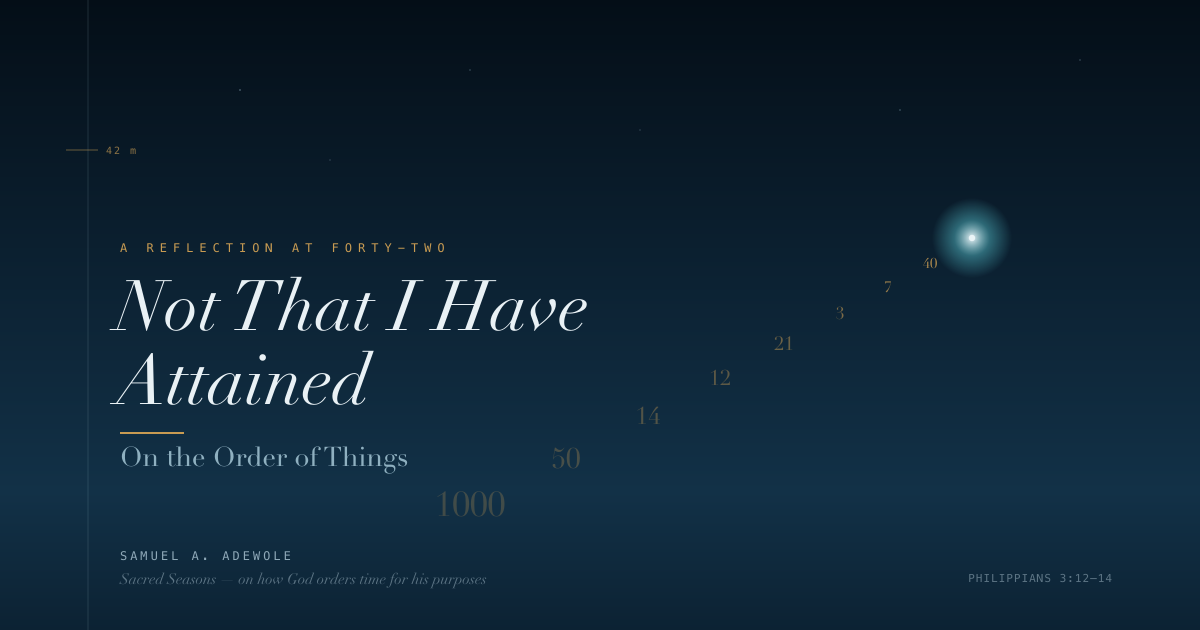

Two years ago I went looking for something. This year it became a book. The search is not over.
Not that I have already attained, or am already perfected; but I press on, that I may lay hold of that for which Christ Jesus has also laid hold of me… reaching forward to those things which are ahead, I press toward the goal for the prize of the upward call of God in Christ Jesus.
Philippians 3:12–14 (NKJV)
Paul writes that sentence as a man who has seen the risen Christ, planted churches across the Mediterranean, and written letters that would outlive every empire he walked through. And he opens with a denial. Not that I have already attained.
I have thought about that construction all year. It refuses the choice most of us try to make — between having arrived and still searching. Paul holds both. He has laid hold of something real, and he is still pressing on. Possession and pursuit, in the same breath.
That is the only honest way I know to write this year's reflection.
The Search, Traced
Two years ago, at 40, I wrote Reflect, Refocus, and Thrive. It was a reckoning with four decades — the trials, the closed doors, the year when everything I touched failed, the healing, the job I never applied for. Somewhere in that piece, almost as a footnote, I noticed something about numbers. Forty years. Forty days. The way Scripture keeps counting.
I did not know what I had found. I wrote a first draft of something and set it aside.
At 41, in From Reflection to Reality, the reflection had become a startup, a rope called hope, a health scare that clarified everything, and a community of readers who kept the work alive when the market was indifferent.
This year the thing I set aside two years ago came back finished.
Sacred Seasons: Ten Meditations on How God Orders Time for His Purposes. Eleven chapters. The Forty — preparation before promotion. The Seven — when God says it is finished. The Three — death that becomes resurrection. The Twenty-One — persistence until the breakthrough. The Twelve, the Fourteen, the Fifty, the One Thousand. And then the Fullness of Time, where every sacred season converges in Christ.
When I opened the preface to check it, I found my own words from the 40th birthday article sitting there as an epigraph, beside Ecclesiastes 3 and Psalm 31. My times are in Your hand. The search had written the book. The book now explains the search.
And here is what I actually found, which was never what I went looking for. It was never about the numbers. It was about the ordering.
Three Letters, One Search
I did not set out to write a trilogy. Each year I simply sat down on my birthday and put on paper what the year had taught me, with no thought for the year before or the year after. It is only now, with three of them side by side, that I can see they were never really three essays. They were one search, arriving in order.
At forty, I wrote a reckoning — twelve lessons drawn from four decades, including the year when everything I touched failed, and the job I never applied for that found me anyway. That was reflection: looking back and naming what the trials had made.
At forty-one, the reflection was dragged into the daylight and tested. A startup with no guarantees. A health scare that reorganised what mattered in a single afternoon. I learned that the only rope worth holding is hope, and that favour and timing carry more than effort alone. That was reality: the lesson put under load, to see whether it held.
And at forty-two, the thing I had been circling without naming finally showed itself. Not a new lesson, but the pattern beneath all the others — the ordering. That was understanding: the moment the search could finally see what it had been looking for.
Reflection, then testing, then understanding. I promise you I did not plan that shape. Which is precisely why I trust it. There is a chapter in Sacred Seasons on the number three — the three days between a death and a resurrection, the pattern God keeps returning to when he wants to make something new out of something finished. I wrote that chapter about Scripture. I did not notice, until I lined these three letters up, that I had quietly been living it.
If even a man's private birthday notes arrange themselves into a sequence he did not design, then perhaps the claim at the centre of the book is truer than I dared to say it out loud: you are not behind. The order is already keeping itself — whether or not you can yet see it.
Six Feet From the King
There is a Yoruba adage about standing six feet close to the king and seven feet away from him. It is usually read as a lesson in reverence — be close enough to serve, never so familiar that you mistake yourself for the throne. The man and the office are two different things.
This year I started to see it as a lesson about purpose.
As influence grows, as the gift opens doors, as the work begins to touch lives, it becomes very easy to believe the greatness belongs to you. That is where people lose the plot. They get so close to the assignment that they start behaving like owners instead of stewards.
The proverb teaches a different posture entirely: stay close enough to fulfil the assignment, keep enough reverence to remember it was entrusted. Your gift is a responsibility. Influence is borrowed weight. Every assignment has a giver, and every giver eventually asks what was done with what was given.
The discipline is to carry success with the same reverence you carried the dream — before the success arrived.
Greatness, like happiness, is a convertible resource. It is an ice cube. Its entire value is in using it to effect something else.
Holding on to it is foolishness, and time will punish you for it. Clutch it and you are left with wet hands and nothing built.
The Order of Loves
Augustine worked this out sixteen hundred years ago and called it ordo amoris — the order of loves. His claim is startling in its simplicity: nothing you love is the problem. Money is not evil. Work is not evil. Ambition, pleasure, success — none of it is evil.
The disorder is in the ranking.
A man loves his career. Good — careers feed families. But rank the career above the family it exists to feed, and he becomes a stranger in his own house. The children grow up and he misses it. He loved a good thing in the wrong slot.
A mother loves her child. The highest natural love there is. But rank even the child above everything, and watch the love curdle into control, anxiety, suffocation — the child made to carry a weight no child was built for.
Same loves. Wrong order. Misery manufactured out of good things. Augustine called that sin — not loving a bad thing, but loving good things out of order.
So what goes in the top slot? Whatever sits there has to be big enough to bear the weight. Your spouse cannot carry it. Your children cannot carry it. Your career certainly cannot — ask anyone who has reached the top of one. Only the highest thing belongs in the highest place. Put God there, and everything underneath finally sits where it belongs. The career serves the family. The family points beyond itself. Nothing gets crushed.
And here is the examination, which I have found merciless: do not ask what you love — you will lie. Ask what you sacrifice for. That is your real ranking.
Now set that beside Sacred Seasons and you will see why the book took two years to find me.
Augustine orders loves. God orders time. It is the same doctrine on a different axis. The disorder in a life is a failure to put things in their right place; the disorder in a season is a failure to read the right time. Which is why the deepest line in the book is also the most practical thing I know: you are not behind on God's calendar. Your forty is not wasted. Your three days of darkness will have a morning. Your twenty-one days of contending prayer already has an answer dispatched.
Every delay is directional. Every wait has a why.
What Actually Underpins a Life
Two more orderings earned their place this year, and I will name my sources plainly — because borrowed wisdom worn as your own is only a subtler disorder of loves.
The first I take from Tony Robbins, who has spent a career reducing human motivation to six needs. Four belong to the personality and quietly war with each other: certainty and variety pull opposite ways; significance asks you to stand apart while connection asks you to belong. Spend a life swinging between those four and you will always feel divided. But beneath them sit two more — growth and contribution, the needs of the soul — and these fight nothing. Expand, and give beyond yourself. Get those two right and the four above them stop tearing at each other. Robbins built the frame; I only note how neatly it maps onto an older claim than his — that a man is steadied not by what he accumulates but by what he becomes and what he gives.
The second ordering is about foundations, and I have heard it preached more often than I can trace to a single voice. Identity gives a man stability — a man still inside an identity crisis leads from insecurity, and the insecurity always leaks into how he leads. Calling gives him direction. Character — not fame, not position — gives him credibility that survives testing. And relationship gives him meaning, because relationship is the one thing that reaches into identity, calling, and character, draws them out, and holds them accountable.
On calling, one correction worth making. The line about your gifts meeting a human need is endlessly attributed to Aristotle; it isn't his. The real version belongs to Frederick Buechner: the place God calls you to is the place where your deep gladness and the world's deep hunger meet. Deep gladness and deep hunger. Not one without the other. That is a higher bar than the version people quote, and a better one.
Calling does not mean you become a pastor. It means the gifts God placed in you are aimed at a human need.
The Work
Which brings me to what I actually do with my days.
Digital Security Insights has struck a nerve. Reading cybersecurity as political economy — as a question of power, sovereignty, and who holds the switch, rather than a controls checklist — turns out to be a conversation a great many serious people have been waiting to have. The advisory work has grown from it. So has a book on the subject, in progress.
The subscribers now come from corridors I did not expect and did not court. Some are contributors of power. Some are challengers — and I have come to value the challengers most, because a thesis that only meets agreement has not been tested. The dissenters make the work stronger than the agreers do.
None of this happened because I was clever. It happened at an intersection of preparation and favour, which is the only place anything of mine has ever happened.
And through all of it, my wife Nadine has been the steady thing. Every season this article describes, she carried alongside me. Much of what looks like my endurance is actually hers.
What I Am Longing For
I will be plain about this, because vague gratitude is cheap and I would rather be honest.
What I am longing for in this next season is favour. Favour with God, first and without which none of the rest means anything. Favour with the right people and the right institutions — not access for its own sake, but doors that open onto the actual assignment. Clarity of vision, so that I am not merely busy. And power to pursue the calling — the stamina to finish what I have been given rather than admire it half-built.
I am aware of the tension in writing that paragraph directly beneath a section on borrowed weight. I am asking for increase while preaching that influence is not mine to own.
I do not think that is a contradiction. I think it is the only safe way to ask. A man who has understood the ice cube can be trusted with a bigger one. The asking is not the danger. Forgetting who handed it to you is.
A call for collaborators
The work ahead is bigger than one voice. If you sit anywhere near the seams — European cybersecurity policy, digital sovereignty, critical infrastructure, geopolitical risk, the governance of systems no single framework owns — I would value your perspective on the record. Interviews at your pace, written contributions, collaborative research. Practitioners especially: the people who have been in the room where the framework and the actual risk stopped pointing the same direction.
samuel@digitalsecurityinsights.comThe Journey Continues
At 40 I reflected. At 41 the reflection was tested in the crucible. At 42 I am holding a finished book about how God orders time, written by a man still learning to let his own life be ordered.
Both things are true. That is the whole point of Paul's sentence.
The book exists. The search is not over. The obstacles keep coming, and so do the mercies. Whatever else this season holds, this came out of it — and it will outlast the season that produced it.
Not that I have already attained.
But I press on.